Education systems around the world are undergoing a quiet but powerful transformation as screen free education gains momentum. For years, digital tools were seen as the future of learning, promising efficiency and accessibility. However, growing concerns about attention spans, cognitive overload, and developmental impacts have led educators and parents to reconsider this approach. As a result, alternative education models that limit or eliminate screens are emerging as credible solutions aligned with evolving learning trends focused on depth, engagement, and wellbeing.
This shift does not reject technology entirely but questions its constant presence in learning environments. Screen free education emphasizes direct interaction, hands-on activities, and experiential learning. By reducing screen dependency, students are encouraged to develop critical thinking, creativity, and interpersonal skills. These priorities reflect broader learning trends that value quality of attention over quantity of information. Within alternative education, screen-free approaches are increasingly viewed as a necessary balance to digital saturation.
Why Screen Free Education Is Gaining Popularity
One of the main drivers behind screen free education is concern about child development. Research and observation suggest that excessive screen exposure can affect concentration, emotional regulation, and social skills. Parents and educators are responding by seeking alternative education environments that support healthy development through physical interaction and real-world problem-solving. These choices align with learning trends that prioritize cognitive resilience and emotional intelligence.
Another reason for the rise of screen free education is the desire to restore focus. Digital learning environments often compete for attention with notifications and multitasking. Screen-free classrooms remove these distractions, allowing students to engage deeply with material. This approach supports sustained attention and meaningful understanding, which are increasingly valued in modern learning trends. Within alternative education, focus is treated as a skill to be cultivated rather than assumed.
Core Principles of Screen Free Education
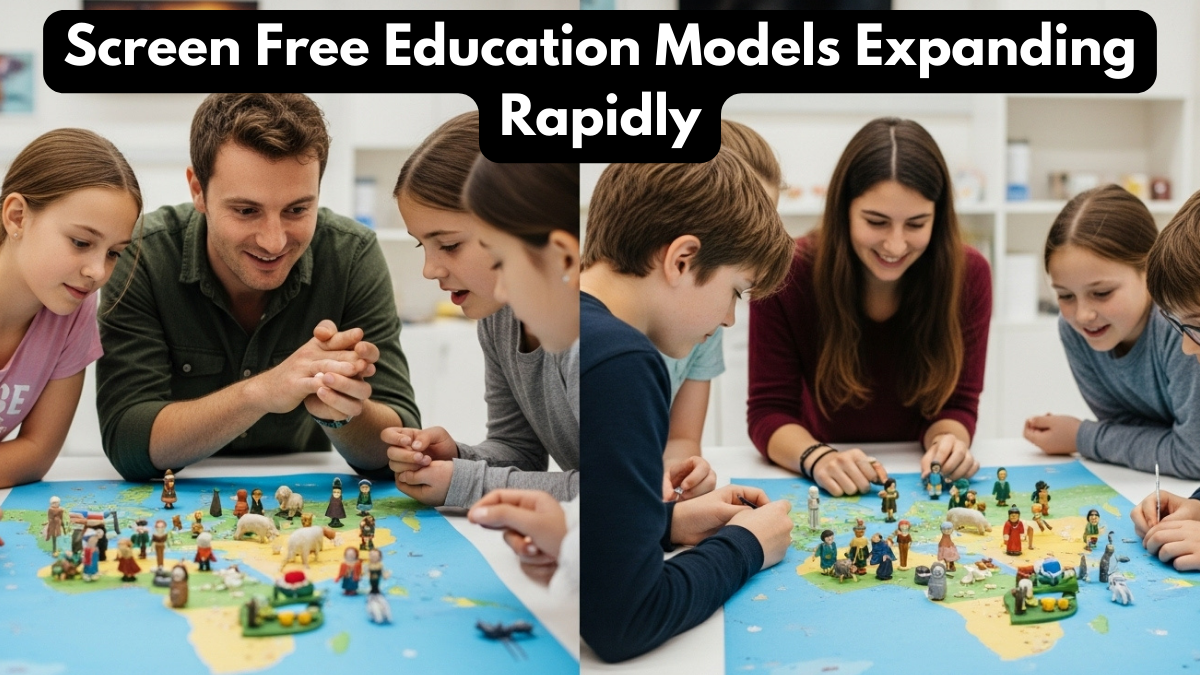
At the heart of screen free education is a commitment to human-centered learning. Lessons are designed to engage multiple senses and encourage active participation. Rather than passively consuming information, students explore concepts through discussion, movement, and creativity. These methods are central to many alternative education philosophies and reflect long-standing pedagogical principles now reinforced by modern learning trends.
Key principles of screen free education include:
- Hands-on learning through physical materials
- Face-to-face collaboration and discussion
- Emphasis on reading, writing, and critical thinking
- Outdoor and experiential activities
- Teacher-led guidance with student autonomy
These principles demonstrate how screen free education aligns with alternative education values while addressing contemporary learning trends focused on engagement and retention.
Comparison of Screen-Based and Screen Free Learning Models
The table below highlights differences between traditional screen-heavy education and screen free education approaches.
| Aspect | Screen-Based Education | Screen Free Education |
|---|---|---|
| Primary Medium | Digital devices | Physical materials |
| Attention Level | Fragmented | Sustained |
| Social Interaction | Limited | High |
| Cognitive Engagement | Passive to moderate | Active |
| Alignment with Learning Trends | Declining | Increasing |
| Role in Alternative Education | Supplementary | Foundational |
This comparison illustrates why screen free education is becoming a core feature of alternative education aligned with emerging learning trends.
Role of Alternative Education in Driving Change
Many of the most successful screen free education models originate from alternative education systems. Montessori, Waldorf, and project-based schools have long emphasized tactile learning and minimal screen use. These models are now influencing mainstream education as concerns about digital overload grow. By aligning with proven learning trends, alternative schools demonstrate that effective learning does not require constant technology.
Public and private institutions are increasingly integrating screen-free elements into curricula. Hybrid models allow technology to support research and communication without dominating daily learning. This balanced approach reflects evolving learning trends that emphasize intentional technology use. Screen free education thus acts as a corrective force, ensuring that digital tools enhance rather than replace human interaction.
Long-Term Impact on Learning and Development
The long-term implications of screen free education extend beyond academic performance. Students educated in low-screen environments often develop stronger communication skills, creativity, and self-regulation. These traits are essential for adaptability in a rapidly changing world. As learning trends shift toward lifelong learning and critical thinking, screen-free foundations provide a strong base.
Additionally, screen free education supports mental and emotional wellbeing. Reduced screen exposure is associated with improved sleep, reduced anxiety, and better physical health. These benefits reinforce the value of alternative education approaches that view learning as a holistic process. As awareness grows, screen-free models are likely to influence education policy and design on a larger scale.
Conclusion
The expansion of screen free education reflects a growing recognition that learning is fundamentally a human process. By aligning with alternative education principles and emerging learning trends, screen-free models address the limitations of screen-heavy environments. These approaches prioritize focus, creativity, and connection, offering students skills that extend far beyond academics. As education systems evolve, screen free education is poised to play a central role in shaping healthier, more effective learning experiences for future generations.
FAQs
What is screen free education?
Screen free education is an approach that minimizes or eliminates digital devices to support focus and hands-on learning.
Why are alternative education models promoting screen free learning?
Alternative education emphasizes holistic development, which aligns with reduced screen exposure and experiential learning.
Do learning trends support screen free education?
Yes, current learning trends highlight attention, critical thinking, and wellbeing, all supported by screen-free methods.
Is screen free education realistic in modern schools?
Many schools adopt hybrid approaches, using screens selectively while maintaining screen free education principles.
Does screen free education improve learning outcomes?
It often improves focus, engagement, and social skills, supporting long-term learning aligned with modern learning trends.
Click here to learn more